
 Phone/WhatsApp 008618939512185
 Email: info@hcrefractory.com
Phone/WhatsApp 008618939512185
Email: info@hcrefractory.com



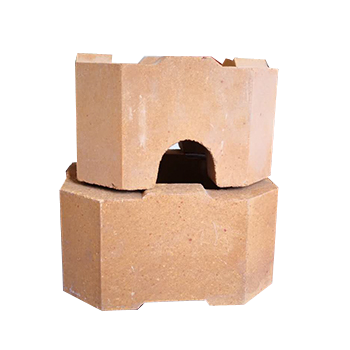
Magnesia brick
Model Number:MZ-91,MZ-92,MZ-93,MZ-94,FMZ-95,FMZ-96,FMZ-97,FMZ-98
Certification:ISO 9001-14001
Minimum Order Quantity:5MT
Magnesia brick description
The refractoriness of magnesia bricks can reach above 2000 °C, and the load softening temperature varies greatly depending on the melting point of the cement phase and the amount of liquid phase produced at high temperatures. Generally, the load-softening start temperature of magnesia bricks is between 1520 and 1600 °C, while that of high-purity magnesia bricks is up to 1800 °C.The loading softening start temperature of the magnesia brick is not much different from the collapse temperature. The linear expansion rate of magnesia bricks at 20~1000 °C is generally 1.2%~1.4%, and is approximately linear. When a liquid phase appears in a brick at a high temperature, shrinkage suddenly occurs. Magnesia bricks have a higher thermal conductivity and are second only to carbon bricks and silicon carbide bricks in refractory products, which decrease with increasing temperature.The thermal shock resistance of the magnesia brick is poor, and the purity of the magnesia brick can be improved to provide thermal shock resistance. Magnesia bricks have poor resistance to acid slag and cannot be directly contacted with silica bricks when used. Generally, they are separated by neutral bricks. The electrical conductivity of magnesia bricks at room temperature is very low, but it cannot be ignored at high temperatures (such as 1500 ° C). If used in electric furnace bottoms, attention should be paid.
Magnesia bricks have poor hydration resistance, easy to hydrate with water, and cracks and reduce their strength. Therefore, pay attention to moisture, rain and snow during storage and transportation.
General Magnesite brick
Item | MZ-91 | MZ-92 | MZ-93 | MZ-94 | |
Chemical composition % | MgO ≥ | 91 | 92 | 93 | 94.5 |
SiO2 ≤ | 4.0 | 3.5 | 2.5 | 2.0 | |
Fe2O3 ≤ | 1.3 | - | - | 1.2 | |
CaO ≤ | 2.5 | 2.5 | 2.0 | 1.8 | |
Apparent Porosity% ≤ | 18 | 18 | 18 | 18 | |
Bulk Density g/cm3 ≥ | 2.86 | 2.90 | 2.95 | 2.92 | |
Cold Crushing Strength Mpa ≥ | 60 | 60 | 50 | 60 | |
0.2Mpa Refractoriness Under Load T0.6 ℃ | ≥1570 | ≥1560 | ≥1620 | ≥1650 | |
Permanent Linear Change On Reheating(%)1500℃X2h | 0~+0.4 | 0~+0.4 | 0~+0.4 | 0~+0.4 | |
Thermal Shock Resistances 100℃ water cycles | ≥18 | ≥18 | ≥18 | ≥18 | |
Fused Magnesite brick
Item | Behaviors | ||||
Fused Magnesia Brick | |||||
FMZ-95 | FMZ-96 | FMZ-97 | FMZ-98 | ||
Chemical composition | MgO % | ≥94.5 | ≥95.5 | ≥96.5 | ≥97.5 |
SiO2 % | ≤1.5 | ≤1.2 | ≤1.0 | ≤0.5 | |
CaO % | ≤1.5 | ≤1.2 | ≤1.2 | ≤0.6 | |
Apparent Porosity % | ≤18 | ≤18 | ≤17 | ≤15 | |
Cold Crushing Strength Mpa | ≥55 | ≥60 | ≥60 | ≥60 | |
0.2Mpa Refractoriness Under Load T0.6 | ≥1650 | ≥1680 | ≥1700 | ≥1700 | |
Bulk Density g/cm3 | ≥2.95 | ≥3.0 | ≥3.05 | ≥3.05 | |
Thermal Stability 950℃ Wind cycles | ≥15 | ≥20 | ≥20 | ≥20 | |
