
 Phone/WhatsApp 008618939512185
 Email: info@hcrefractory.com
Phone/WhatsApp 008618939512185
Email: info@hcrefractory.com



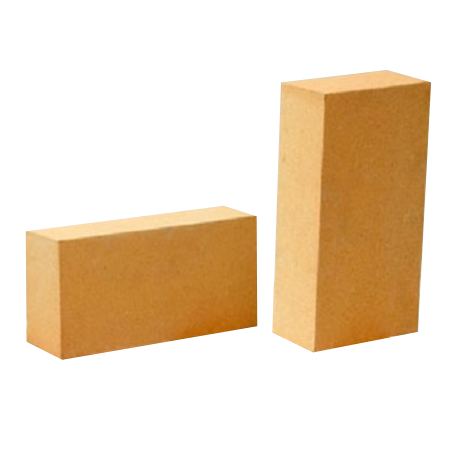
Fire clay brick
Model Number:N-2a,GN-42,JZN-40,CN-40,SN-40,XN-40,KN-40,ZN-40,DN-40
Certification:ISO 9001-14001
Minimum Order Quantity:5MT
Fire clay brick description
Fire clay brick is a refractory product with Al2O3 content of 30%~48% produced from refractory clay. Fire clay bricks are widely used in many thermal equipment such as blast furnaces, hot blast stoves, steel linings and steel casting systems.Fire clay bricks are divided into ordinary fire clay bricks, multi-cropped fire clay bricks, whole-cropped fire clay bricks and high-silice fire clay bricks.
Ordinary fire clay bricks refer to varieties with Al2O3 content between 36% and 42%, with high yield and wide application. Ordinary fire clay bricks are made of soft clay with high plasticity and dispersibility and a part of clay clinker. Generally divided into fire clay-clinker brick and fire kaolin-clinker brick. Their main high-temperature performance refractoriness, special grades greater than 1750 ° C, first grade is 1730 ~ 1750 ° C, second grade is 1670 ~ 1730 ° C, third grade is 1580 ~ 1670 ° C.
Multi-crop fire clay bricks refer to products containing more than 80% clinker and 20% or less of clay. Due to the fact that most of the billet clinker is in a deuterated state, it is not easily deformed during the manufacturing process, and the outer dimensions of the brick can be ensured, and the fired product has an ideal bulk density, mechanical strength, thermal shock resistance and high Refractoriness.
Whole-crop fire clay bricks, also known as clinker-free fire clay bricks, are made of hard clay or pyrophyllite with low plasticity, low dispersibility, and low shrinkage. Since the raw material inherently has a small amount of water, the original particle composition can be maintained although a certain amount of added water is imparted after the pulverization. Therefore, no clinker can be added, and the finished product does not shrink due to the absence of clinker.
The main raw materials for high-silice fire clay bricks are deuterated clay (calcined hard clay, kaolin or pyrophyllite) and natural quartz sand. According to different raw material categories, high-silice fire clay bricks can be divided into quartz-kaolinite high-silica bricks and quartz-clay high-silica bricks. The former has a maximum content of SiO2 of 75% to 80%, a refractoriness of more than 1710 ° C, and a typical porosity of more than 25%; the latter is composed of quartz containing quartzite or quartz sand in sintered hard clay. The refractoriness of the product is low, generally between 1610 and 1700 °C. High siliceous clay bricks are stable in volume at a certain temperature. Long-term use does not produce excessive volume expansion or shrinkage, and the load softening temperature is higher than ordinary clay bricks. It is very suitable for building regenerators or steel drums. lining.
Technological process
Fire clay brick production mainly consists of five processes of crushing and crushing, compounding and mixing, forming, drying and firing.
Item | General clay fire bricks | Fire bricks for blast furnace
| Fire bricks for hot-blast stove | Fire bricks for pouring | Fire bricks for the lining of temming ladle | Fire bricks for steel pouring | Low pore fire bricks |
Brand | N-2a | GN-42 | GN-42 | JZN-40 | CN-40 | SN-40 XN-40 KN-40 ZN-40 | DN-40 |
Al2O3% min | 42 | 42 | 42 | 40 | 40 | 42 | |
Fe2O3% max | - | 1.7 | - | - | - | - | - |
Refractoriness(℃) min | 1730 | 1750 | 1750 | 1710 | 1730 | 1710 | 1730 |
Refractoriness under load of 0.2Mpa(℃) min | 1350 | 1430 | 1400 | -- | 1400 | 1370 (SN-40, KN-40) | 1390 |
Apparent porosity% max | 24 | 16 | 24 | 17-25 | 19 | 15-23 (SN-40) 22 (KN-40) 15-25(XN-40) 23(ZN-40) | 15 |
Linear change on reburning% | +0.1-0.5 1400℃X 2h
| 0-0.3 1450℃ X 2h
| 0-0.3 1450℃ X 2h
| +0.1-0.3 1350℃ X 2h
| 0-0.3 1400℃ X 2h
| 0-0.3 1350℃ X 2h (XN-40)
| +0.1-0.3 1400℃X 2h
|
